

Which Three-Row Electric SUV Actually Makes Sense for Your Family

Shopping for a three-row electric SUV means you’re probably looking at two names that keep popping up: the 2026 Kia EV9 and the Hyundai IONIQ 9. Both come from the same parent company, both promise serious family-hauling capability, and both deliver on electric range. So what’s the real difference, and which one actually makes sense for your garage? Let’s break down what sets these Korean siblings apart and why the Kia might be the smarter pick.
- Kia’s EV9 starts at $54,900 while the IONIQ 9 begins at $58,955, giving you a $4,000 price advantage right from the start.
- While the IONIQ 9 offers slightly more cargo space and third-row legroom, the EV9 delivers faster acceleration, more trim variety, and better overall value.
- Both SUVs handle DC fast charging in about 24 minutes and can tow up to 5,000 pounds with all-wheel drive configurations.
Price and Power Make the First Impression
When comparing the 2026 Kia EV9 vs. Hyundai IONIQ 9, your wallet notices the difference immediately. Kia’s EV9 Light RWD kicks things off at $54,900, while the IONIQ 9 S starts at $58,955. That’s real money you could spend on charging equipment or your first road trip.
Power delivery is where things get interesting. Kia offers single-motor rear-drive setups producing 215 horsepower in the base model, then jumps to 379 horsepower with dual-motor all-wheel drive. Want even more? Their GT-Line AWD brings sport styling, and Kia’s planning a full GT model with 501 horsepower that’ll hit 60 mph in about 4.2 seconds. That’s supercar territory in a family SUV.
Hyundai counters with three powertrains: a 215-hp rear-drive base, a 303-hp AWD setup, and a Performance AWD variant pumping out 422 horsepower. Quick? Sure. But Kia’s performance range gives you more choices at different price points.
Range, Batteries, and Real-World Driving
Battery capacity tilts in Hyundai’s favor. Every IONIQ 9 gets a massive 110.3 kWh battery pack, delivering at least 300 miles of range across the lineup. Their Long Range RWD stretches that to 335 miles, which beats the EV9’s maximum 304-mile range.
But hold on. Kia’s 99.8 kWh battery in most trims gets you 304 miles in the Long Range configuration, and that’s plenty for most families. Daily commuting? Weekend trips to grandma’s house? You’re covered. Both SUVs charge at up to 239 kW, meaning you’ll go from 10% to 80% in roughly 24 minutes at a proper fast charger. They’re both compatible with Tesla’s Supercharger network via NACS ports too.
Kia’s smaller base battery (76.1 kWh) in the Light RWD trim offers 230 miles, which might seem limited. But if you’re mostly driving around town, that’s still a week’s worth of commuting between charges.
Space, Comfort, and Family-Friendly Features
Both SUVs seat up to seven people across three rows, with optional second-row captain’s chairs that drop capacity to six. Hyundai’s IONIQ 9 is slightly larger in every dimension (2 inches longer, 1.6 inches taller), which translates to more space inside.
Cargo capacity goes to the IONIQ 9: 21.9 cubic feet behind the third row versus 20.2 for the EV9, and 86.9 cu ft total versus 81.7 for Kia. Third-row passengers get an extra 1.2 inches of legroom in the Hyundai (32 inches versus 30.8 inches).
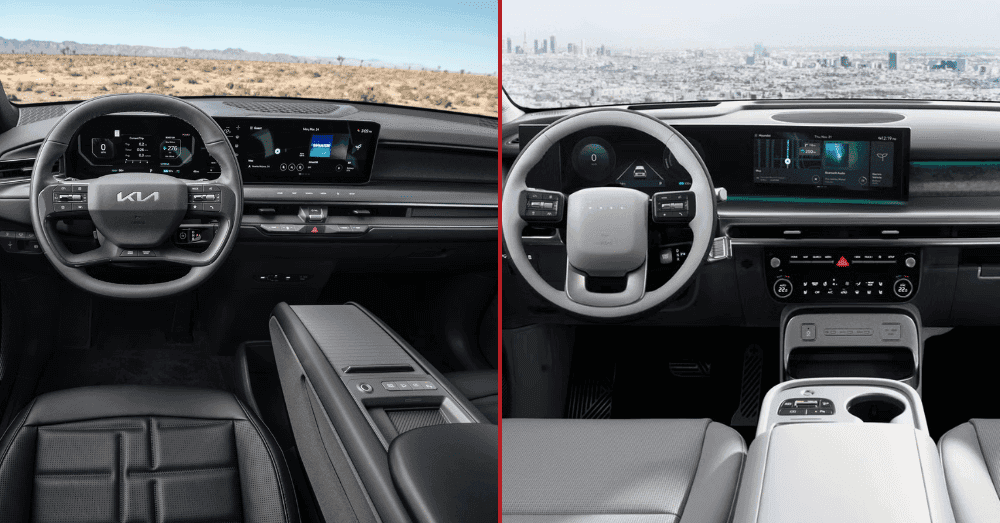
Kia counters with standard ventilated front seats on more trim levels, a useful frunk for extra storage, and an interior design that feels less fussy. You get actual buttons for climate controls instead of relying entirely on touchscreen menus. Real drivers appreciate tactile feedback when they’re adjusting the temperature while keeping eyes on the road.
Technology and Safety Come Standard
Both vehicles roll out with dual 12.3-inch displays, wireless Apple CarPlay and Android Auto, and head-up displays on upper trims. Safety tech is generous across the board: forward collision warning, automatic emergency braking, blind-spot monitoring, lane-keeping assist, and adaptive cruise control come standard.
Hyundai adds some luxury touches like second-row massage seats and a UV-C phone cleaning station on higher trims. Kia responds with its optional Nightfall Edition package, which wraps the SUV in slick black detailing for buyers who want a stealthier look.
Why the EV9 Edges Out the IONIQ 9
When you compare the 2026 Kia EV9 vs. Hyundai IONIQ 9 side by side, Kia wins on value. That $4,000 lower entry price gets you into an electric three-row SUV that does everything most families need. You get practical range, plenty of power, and all the tech and safety features you’d expect.
Kia’s wider trim lineup means you can dial in exactly what you want without overspending. Need basic transportation? Go with the Light RWD. Want performance? Step up to the GT-Line or wait for the full GT. Hyundai’s tighter trim structure gives you less flexibility.
Plus, Kia’s been selling the EV9 since 2023, so there’s more real-world data, more available inventory, and dealers who understand the product inside and out. Hyundai just launched the IONIQ 9, which means early adopters might encounter growing pains.
Finding Your Electric SUV in Indianapolis
If you’re in the Indianapolis area and ready to experience what makes the EV9 special, Ray Skillman Southside Kia has the expertise and inventory to help. They’re equipped to answer your questions about electric range, charging infrastructure, and how the EV9’s various trim levels stack up. Their sales team knows the ins and outs of EV ownership, from home charging setup to maximizing that federal tax credit (yes, the EV9 qualifies for the full $7,500 since it’s built in Georgia). Whether you’re comparing cargo space for family road trips or trying to figure out if 304 miles of range fits your daily routine, Ray Skillman Southside Kia can walk you through the numbers. They serve families throughout Indianapolis, Greenwood, Plainfield, and beyond, and they’re committed to making the switch to electric as straightforward as possible. Stop by for a test drive and see how the EV9’s blend of technology, space, and value could work for your family.
